Buildings
Like an archaeological dig, the route visitors take when exploring Pointe-à-Callière is both vertical and horizontal, lined with traces of past centuries. The Museum consists of six buildings and structures: the Éperon, Place Royale and the archaeological crypt, the Ancienne-Douane, the Youville Pumping Station, the Archaeological Field School and the Mariners House.
Éperon Building

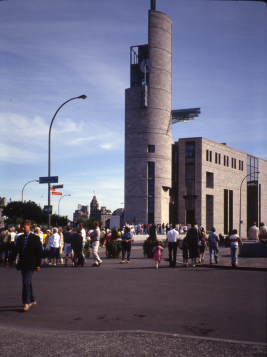
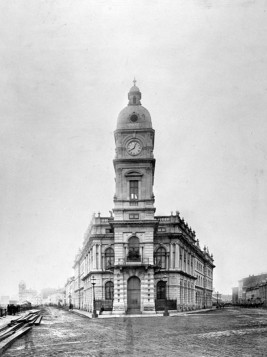
Marking the entrance to the Museum, the Éperon building is an inspiring piece of architecture, rising from the foundations of its predecessor – the Royal Insurance Company building. Like that earlier edifice, the Éperon is triangular in shape and boasts a tower that looks out over the Port of Montréal.
It houses the reception desk, the Hydro-Québec multimedia theatre, a temporary exhibition hall, a restaurant and, in the basement, part of the permanent exhibition Where Montréal Was Born.
Place Royale and the archaeological crypt

Outside, between the Éperon and Ancienne-Douane buildings, lies Place Royale. In summer it comes alive with shows, concerts and even an 18th-century outdoor market, all in keeping with its former role as a public square.
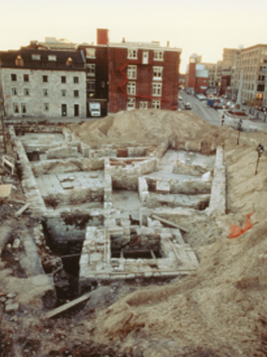
Archaeological digs and historical research have been going on since 1979 in Place Royale, near the birthplace of Montréal, at the confluence of the St. Lawrence and Little St. Pierre rivers. The fascinating finds there tell us a great deal about the daily life of Natives and the first Montrealers, many years ago. It sits above the remains of fortifications and buildings from the 17th, 18th and 19th centuries.
The archaeological crypt lies beneath Place Royale and links the Éperon and Ancienne-Douane buildings underground. The archaeological remains and artifacts in the crypt are part of the permanent exhibition Where Montréal Was Born.
Ancienne-Douane Building

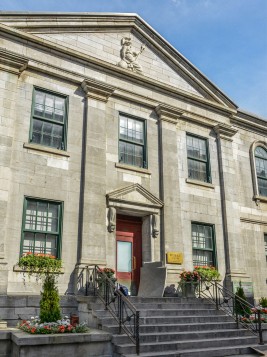
This building, designed by architect John Ostell, dates back to 1836–1837 and originally housed Montréal’s first Custom House (its name means “the Old Custom House”). It was expanded in 1881 and today is home to the museum gift shop on the ground floor and the permanent exhibition Montréal Love Stories – The Cultural Connection upstairs.
This neoclassical building was the first major project by architect, engineer and surveyor John Ostell, and one of the first architectural signs of the British presence in Montréal.
Youville Pumping Station

The Youville Pumping Station, at 173 Place d’Youville (just across the street from the Éperon building), was Montréal’s first electrically operated wastewater pumping station. The building, now converted into an interpretation centre, dates from 1915 and showcases some ingenious artifacts that are nearly a century old. Carefully preserved motors, pumps, valves and electrical equipment are now used to explain the role, components and operation of the station. It takes history to a whole new “level”!
The station was originally designed by English engineer Stuart Howard. With its Victorian façade and lovely Scottish brick, it represented a great step forward in the city’s technological and civic development in the early 20th century.
Archaeological Field School

In January 2000, Pointe-à-Callière acquired the property at 214 Place d’Youville, near the Éperon building. The building dates from the 19th century and was erected in part on Montréal’s birthplace. It had been occupied for over 75 years by the Townsend company, a ship’s chandler serving the Port of Montréal. The company had been in operation up until 1998, offering everything ships and their crews needed for their voyages. Since 2002 this has been the home of Pointe-à-Callière’s Archaeological Field School. The Museum’s research there has turned up traces of Callière’s Residence and Fort Ville-Marie.
Mariners House

The Mariners House, at 165-169 Place d’Youville, is the Museum’s latest acquisition. In 1875, the Montreal Sailors’ Institute was established here, to serve merchant mariners stopping over in Montréal. By 1940, the Institute had outgrown the building and, in the midst of the war, its Board of Directors commissioned architect C.R. Titley to draw up plans for a new building. Construction was delayed until 1953, however, because of shortages of materials and labour. In 1987, the Oeuvres de la maison du Père acquired the building to house men in difficulty. Its name then changed to the Résidence du Vieux-Port.
Pointe-à-Callière purchased the building in 2004, to be used for school groups. The Museum now has several rooms it can use for workshops and to house its educational collections. In addition, as part of Pointe-à-Callière's expansion plans, this building will be converted into the Archaeology House.
Architecture
Building today, on yesterday, for tomorrow
The Éperon Building
By “memory” we mean all the work that allows us to preserve recollections of the past, that collective ability to recall the events that marked the founding of Montréal. To respect this memory, the architects took pains to fit the Éperon building into its existing architectural surroundings. The building is a splendid example of integration with its older neighbours; its contemporary architecture respects the proportions of the Royal Insurance Company building that previously stood on this site.
The Éperon building is an extension of all the façades along Rue de la Commune. It conforms with the historic quarter, matching the roof lines and the proportions of walls and openings. Its transparency actually enhances the heritage buildings surrounding it.
The tower of the building, with its characteristic and easily identifiable structure, becomes the central element of the Museum complex.
“The challenge was to build, and preserve at the same time. It was both inhibiting and stimulating,” recounts architect Dan S. Hanganu.
The focal point of the Museum is a contemporary building. This masonry structure was built on top of the underground remains, and the new elements are clearly identified. The Éperon building is supported on a complex system of piles penetrating right down to the bedrock. Its foundations are designed both to preserve the archaeological remains and to allow further exploration in future.
In various locations, openings in its walls give visitors a glimpse of the old foundations on which the new building was constructed. The Éperon building shows how the past and present can co-exist in harmony.
The Ancienne-Douane building
The architects, LeMoyne Lapointe Magne, treated the Ancienne-Douane building like a monument. They managed to conserve its outside walls and its doors and windows, confining all changes to the interior.
The Ancienne-Douane building sits next to the foundations of bygone buildings and the remains of the first fortifications of Montréal. The building was almost square when it was first erected in 1836 by architect John Ostell. In 1881, as can be seen in the basement, it was expanded, the façade being moved several metres forward to de la Commune.
Aside from its Palladian style, the true interest of this old building lies in the textures, finishes, patinas and construction details that today’s architects have integrated into the new structure.
They breathed new life into this treasure and made it still more attractive, renovating in keeping with the tone of the original building.
Here the architects have employed transparency: keeping and exposing the existing framework. All the complex modern heating, ventilation, electricity, humidity control and fire prevention systems are discreetly integrated and hidden away in the attic.
In renovating the building, the architects managed to respect its character and adapt it to the needs of this modern museum.
From : Pointe-à-Callière, Experience the past! / [Editor, Marc Boudreau ; Contributors, Nicole M. Boisvert... et al.]. pp. 30-35
Architects and awards
Senior architect, Éperon and archaeological crypt : Dan S. Hanganu / Provencher Roy, architects
Consulting architect, Ancienne-Douane : Lemoyne Lapointe Magne, architects and urban planners
- Governor General's Medal for Architecture, to Dan S. Hanganu and Provencher Roy, architects, for the architectural quality of the Museum; the medal was presented to Pointe-à-Callière, 1994
- Grand Prize from the Ordre des architectes du Québec, to Dan S. Hanganu and Provencher Roy, architects, for the Éperon building and the archaeological crypt, 1993
- Orange Award from Sauvons Montreal, for the architecture of the Éperon building and its integration into the urban environment, 1992
- Certificate of Excellence from Event Graphic Design,for the Ancienne-Douane building, in the Environmental Design category, 1992
Fact Sheet
| Name | Pointe-à-Callière, Montréal Museum of Archaeology and History | |
| Visual Image |
![]() References are geographic (point, uneven shoreline), architectural (triangular footprint of the Éperon building, tower and elevator) and museological (stratigraphy, vertical dimension) |
|
| Official Opening |
May 17, 1992 (to mark the 350th anniversary of the founding of Montreal). |
|
| Average number of visitors |
More than 300,000, of all ages, from all over ..(en) |
|
| Total area |
10 690 m2 (exhibition space : 5 970 m2) | |
| Theme | Montréal, a crossroads of cultures and trade | |
| Exhibitions | 4 permanent and 2 temporary each year | |
| Project owner |
Ville de Montréal | |
| Master contractor |
Société immobilière du patrimoine architectural de Montréal (SIMPA) | |
| Partners | Communications Canada Federal Office of Regional Development (Québec) Ministère des Affaires culturelles du Québec City of Montréal |
|
| Project management |
Director: Francine
Lelièvre, Processus inc. Project manager, architecture: Yves Roy Project Manager, research/museology: Sylvie Dufresne |
|
| Senior architect |
Dan S. Hanganu/Provencher Roy | |
| Consulting architect |
Lemoyne Lapointe Magne Architectes et Urbanistes (Ancienne-Douane) | |
| Structural and civil engineers |
Nicolet Chartrand Knoll ltée | |
| Mechanical and electrical engineers |
Liboiron Roy Caron & Associés inc. | |
| Contractors | Construction Fitzpatrick Canada
ltée Construction Canvar Les entreprises Véral inc. Les fondations Géodex inc. |
|
| Historical research |
Raymond Montpetit, co-ordinator Paul-André Linteau, historian Jean-Claude Marsan, architect and urban planner Jacques Mathieu, historian and their teams |
|
| Archaeological research and dig sites | Ville de Montréal Old Port of Montréal Corporation Arkéos Arkhis Ethnoscop Groupe de recherche en histoire du Québec Antiquarian and Numismatic Society of Montréal |
|
| Funding | Project cost : $27,500,000 Government of Canada (Communications Canada and Federal Office of Regional Development – Quebec): $12,000,000 Ministère des Affaires culturelles du Québec : $9,000,000 City of Montréal : $6,500,000 |